
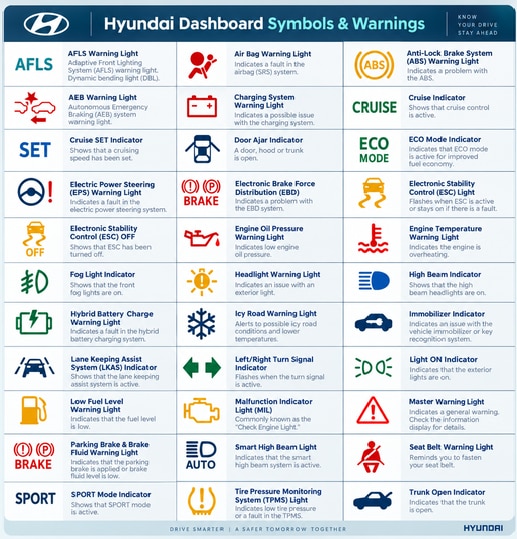
You’re driving down the highway when suddenly a bright symbol illuminates on your instrument cluster
Whether you drive a Tucson, Elantra, Santa Fe, or Palisade, your vehicle’s on-board diagnostic system is continuously monitoring critical safety systems, engine components, and fluid levels
The Color Code: Understanding Light Severity
Before diving into specific symbols, pay close attention to the color of the light illuminating your dashboard
-
Red Lights (Critical Warning): Indicate a serious safety risk or potential mechanical failure
. You should safely pull over and stop driving immediately to avoid severe engine or safety hazards . -
Yellow / Orange Lights (Caution Warning): Signal an item that needs prompt attention or servicing soon, such as low tire pressure or an engine sensor issue
. -
Blue / Green Lights (Information/System Active): Show active convenience or driver-assist features, such as high beams or Cruise Control engagement
.
Common Hyundai Dashboard Warning Lights & Meanings
| Symbol / Light Name | Color | What It Means | Recommended Action |
|
Check Engine Light |
Yellow |
Indicates an issue with your emissions system, engine sensors, or fuel cap |
If solid, schedule diagnostic service soon. If flashing, pull over safely immediately |
|
Oil Pressure Warning Light |
Red |
Engine oil pressure has dropped below safe operational levels |
Pull over immediately and turn off the engine to prevent total engine destruction |
|
Engine Overheating Light |
Red |
Coolant temperature has exceeded safe limits |
Stop safely, turn off the vehicle, and allow the engine to cool down fully |
|
Battery / Charging Light |
Red |
The vehicle charging system or alternator is malfunctioning |
Turn off non-essential electronics and drive directly to a qualified mechanic |
|
TPMS (Tire Pressure Light) |
Yellow |
One or more tires are significantly under-inflated |
Check tire pressures against recommended PSI levels on your driver-side door jamb |
|
Anti-Lock Brake System (ABS) |
Yellow |
ABS system error; standard braking functions remain available |
Schedule an inspection with a certified technician soon to restore full ABS capability |
|
Brake System Light |
Red |
Handbrake is engaged or hydraulic brake fluid level is critically low |
Ensure the parking brake is disengaged. If light stays on, pull over safely and seek service |
What Should You Do When a Warning Light Turns On?
-
Stay Calm & Assess: Determine the color of the light
. If it’s red or flashing, prepare to safely pull off the road . -
Check the Essentials: For yellow lights like the Check Engine symbol, ensure your gas cap is securely tightened, as a loose cap can trigger the sensor
. -
Avoid Hard Acceleration: If driving with a caution light, drive gently and minimize high-speed highway travel until the vehicle is inspected
. -
Schedule Certified Diagnostics: Modern Hyundai models require specialized diagnostic equipment to correctly pull trouble codes (DTCs)
.
Need Professional Hyundai Service in Kansas City?
If your warning lights remain illuminated, don’t leave your safety to chance
We are committed to providing a seamless experience for drivers from Overland Park, KS, Independence, MO, Lee's Summit, MO, and Blue Springs, MO, with convenient access to expert Hyundai service, maintenance, and support
Trust a qualified Hyundai mechanic at our state-of-the-art Hyundai service center to quickly resolve your dashboard warnings and get you back on the road with total confidence
Frequently Asked Questions (FAQ)
Can I drive with a yellow Check Engine light?
Yes, you can usually drive a short distance with a solid yellow Check Engine light
Why is my Check Engine light flashing?
A flashing Check Engine light indicates a severe engine misfire, which can allow unburnt fuel into the exhaust system and overheat the catalytic converter
How do I reset my Hyundai dashboard light?
While clearing codes using a basic OBD-II scanner is possible, the light will return if the root problem isn't resolved